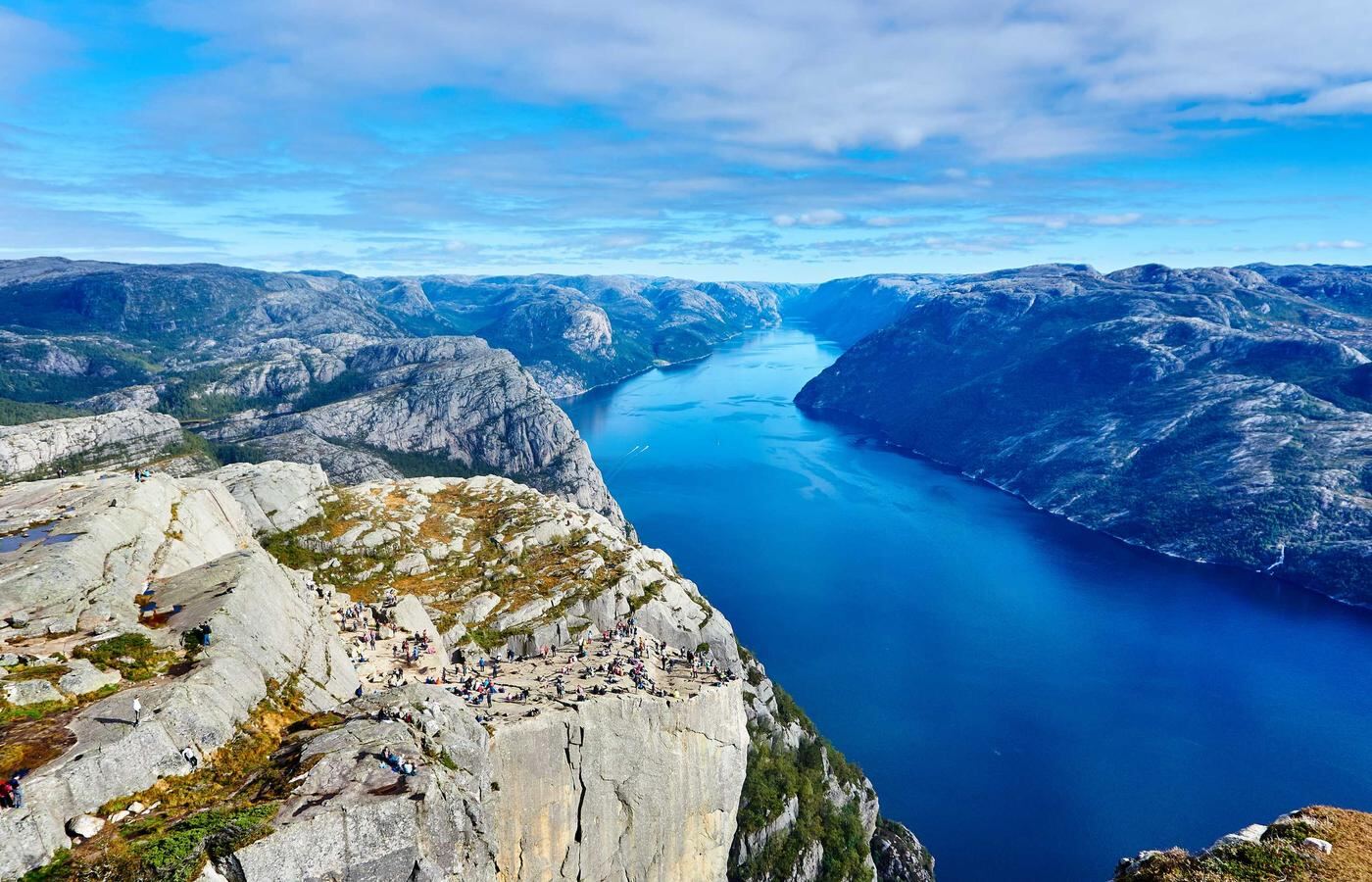
Most longevity advice is measured in milligrams. This one is measured in horizons.
Go Look at Something Big: Awe as a Longevity Practice
The Article That Cannot Be Reduced to a Number
Every other article on this site can be measured. Grams of protein. Minutes in Zone 2. Hours of sleep. Milligrams of creatine.
This one cannot.
That is the point.
What Awe Does to the Body
There is a growing body of research on awe — the specific feeling of encountering something so vast it rearranges your sense of scale. A ridgeline at first light. A night sky with no town for fifty miles. A piece of music that stops you mid-step.
Dacher Keltner’s lab has studied this for years. In a 2015 study, awe was the single strongest predictor of lower interleukin-6 — an inflammatory marker — among all the positive emotions tested. 1
Awe also appears to quiet the self-focused chatter that drives anxiety. Researchers found that it produces a “small self” effect — a shift in attention from your own concerns toward something larger — and that this shift was associated with more generous, patient, and prosocial behavior. 2
It even changes how time feels. People who experienced awe reported feeling less time-pressured and were more willing to give their time to others. 3
Awe behaves, in other words, like a drug we have not learned to sell yet.
Why This Belongs in a Healthspan Guide
The longevity literature keeps circling back to two findings that resist quantification.
People with a strong sense of purpose live longer. A 2019 JAMA study of adults over 50 found those with the strongest sense of purpose had significantly lower mortality. 4 (See The Purpose Effect for the full evidence.)
People with rich relationships live longer. A meta-analysis of 148 studies found a 50% greater survival likelihood for people with stronger social connections.
Both effects rival the size of classic risk factors. Neither fits on a supplement label.
Awe feeds both. It is hard to feel like the center of your own small worries while looking at a glacier. And the places that produce it tend to be places we go with someone, and talk about for years after.
The Version of Longevity Worth Chasing
Here is the quiet thing most longevity content misses.
It is written as if the goal were to survive — to subtract risk until nothing is left to kill you.
But nobody climbs a mountain to subtract risk.
They climb because being up there — tired and small and a little scared — is one of the ways a life feels like it is actually being lived.
That is the version of longevity worth chasing. Not just more years. More years spent doing the thing at the top of the climb.
You can optimize a body into its nineties. Whether those years are worth having is a different question. And it is not answered in a lab.
The Awe Inventory
For the next month, schedule one awe-sized experience per week. Not a vacation. Not a major trip. Something available, something specific:
Week 1: Go see real dark. An hour from most cities is a sky you have forgotten exists. Drive out after dinner. Stay thirty minutes. Look up.
Week 2: Walk uphill until the view changes. The payoff of a summit is disproportionate to its difficulty. The view from a local ridge counts.
Week 3: Go slow enough to notice. Take a familiar trail or path and walk it at half your usual pace. Awe needs attention. A trail run and a trail walk are different medicines.
Week 4: Bring someone. Repeat any of the above with another person. The memory compounds when it is shared.
After four weeks, ask:
Which of these would you do again without being told to?
That is the one worth keeping. Awe does not work as a prescription. It works as a practice — the kind you build into a life because the life is better with it.
When a Book May Help
Some links below include negotiated reader discounts. These and other links on the site may earn the Society a commission — it never changes what you pay. How this works.
If you want the science behind awe laid out properly, Keltner’s Awe is the definitive tour — and a persuasive argument for why the next thing you should schedule is not a blood panel, but a horizon. 5
The rest of this site will help you build a body that lasts.
This pillar is about making sure it goes somewhere.
The Lookout
The awe research is genuine but young. The Stellar 2015 study that links awe to lower IL-6 is correlational — it measured positive emotions and inflammatory markers in the same participants, but did not prove that awe caused the reduction. The direction is consistent across studies, and the biological plausibility is strong (positive emotion → lower cortisol → lower inflammatory markers), but intervention trials specifically testing “awe exposure” as a health intervention are still rare.
The “small self” effect is better established. Multiple studies show that awe shifts attention outward, reduces entitlement, and increases prosocial behavior. Whether this translates to measurable long-term health outcomes is an open question.
What the evidence does support clearly: purpose and social connection are among the strongest predictors of longevity and cognitive preservation. Awe is a reliable pathway to both. You do not need a study to prove that standing on a ridge with someone you care about is good for you. But it is worth noting that the research keeps pointing in the same direction the instinct does.
The Explore pillar exists because longevity without a reason to be alive is engineering without a blueprint. This article is the philosophical foundation the rest of the site is built to serve.
Sources
- 1. Stellar JE, et al. "Positive affect and markers of inflammation: discrete positive emotions predict lower levels of inflammatory cytokines." Emotion. 2015;15(2):129-133. PubMed ↗
- 2. Piff PK, et al. "Awe, the small self, and prosocial behavior." J Pers Soc Psychol. 2015;108(6):883-899. PubMed ↗
- 3. Rudd M, et al. "Awe expands perception of time and enhances well-being." Psychol Sci. 2012;23(10):1130-1136. PubMed ↗
- 4. Alimujiang A, et al. "Life purpose and mortality among US adults older than 50." JAMA Netw Open. 2019;2(5):e194270. PubMed ↗
- 5. Keltner D. Awe: The New Science of Everyday Wonder. Penguin Press, 2023.